
When someone dies owning Pennsylvania real estate, family members often assume the property can simply be transferred to heirs without tax consequences. In many cases that is true. In other cases, Pennsylvania realty transfer tax on estate distributions may apply and create an unexpected expense.
The rules surrounding Pennsylvania realty transfer tax on estate distributions become especially important when inherited property is subject to a mortgage, when one beneficiary wants to buy out other heirs, or when an executor records an estate deed without properly claiming an available exemption.
Pennsylvania imposes a state realty transfer tax on many real estate transfers, and local transfer taxes may also apply. According to the Pennsylvania Department of Revenue’s guidance on Pennsylvania realty transfer tax, a transfer that appears to be an inheritance can still become taxable if the transaction involves consideration or resembles a sale.
Families handling inherited property should also understand that transfer tax issues often arise during Pennsylvania probate and estate administration, particularly when executors distribute real estate to beneficiaries.
Whether you are serving as an executor, administering an estate, or reviewing your family’s estate planning services in Pennsylvania, understanding Pennsylvania realty transfer tax rules can help avoid costly mistakes.
Here are five critical rules families should know about Pennsylvania realty transfer tax on estate distributions before transferring inherited real estate.
Pennsylvania Realty Transfer Tax on Estate Distributions: The Basic Rule
Under Pennsylvania law, certain transfers of real estate from a decedent’s estate to an heir or devisee may qualify for an exemption from Pennsylvania realty transfer tax.
Generally, an estate distribution may qualify for exemption when:
-
- The property passes under a will or through intestate succession.
-
- The transfer is made by the executor, administrator, or personal representative.
-
- The transfer is made to the person legally entitled to receive the property.
-
- The transfer involves no consideration or only nominal consideration.
Pennsylvania’s rules regarding exempt transfers can be found in Pennsylvania realty transfer tax excluded transactions.
The consideration requirement is often where Pennsylvania realty transfer tax on estate distributions becomes complicated.
A true estate distribution differs from a sale. If a beneficiary simply receives inherited property as part of that beneficiary’s estate share, the transfer may qualify for exemption. However, if the beneficiary pays money or assumes obligations in exchange for receiving the property, Pennsylvania realty transfer tax may apply.
The deed, supporting documentation, and exemption claim are critical. Recorders of Deeds and the Department of Revenue rely on the recorded documents to determine whether Pennsylvania realty transfer tax on estate distributions applies.
Rule One: An Inheritance Is Not Always a Taxable Sale
The simplest example of an exempt estate transfer is when a parent dies owning a home, leaves the home to a beneficiary through a will, and the executor transfers the property without requiring payment.
In that situation, Pennsylvania realty transfer tax on estate distributions may not apply because the transfer is a true inheritance rather than a sale.
The same principle may apply when property passes through intestate succession. If heirs receive inherited real estate according to Pennsylvania law and no consideration is exchanged, the estate distribution exemption may be available.
This is where understanding the source of the transfer matters.
A deed from an estate is not necessarily treated the same as a deed from the deceased individual. For Pennsylvania realty transfer tax purposes, the estate is a separate legal entity.
Families often assume that a transfer involving relatives automatically qualifies for a family exemption. That assumption can be dangerous.
For example, a transfer from an estate to a child may qualify under estate distribution rules, but it does not automatically qualify under family transfer rules simply because the parties are related.
The better question is:
Is the transaction a qualifying estate distribution, a taxable sale, a family transfer, or a combination of multiple transactions?
The answer often depends on how the property passes under the will, trust, or intestacy laws. Families working with a wills and trusts lawyer can often identify transfer tax issues before the deed is prepared.
Careful planning can help preserve available exemptions and reduce Pennsylvania realty transfer tax exposure.
Rule Two: A Mortgage Can Create Transfer Tax Even If No Cash Changes Hands
One of the most misunderstood aspects of Pennsylvania realty transfer tax on estate distributions involves mortgages and other liens.
Many beneficiaries assume there is no transfer tax because they are not paying cash to the estate. However, Pennsylvania realty transfer tax rules may treat existing debt as consideration.
A mortgage balance can create taxable consideration even when no money changes hands.
Example
A parent dies owning a home worth $250,000.
The property remains subject to an $80,000 mortgage.
The parent’s only child receives the home through the estate and continues making mortgage payments.
Although the child views the transaction as an inheritance, Pennsylvania realty transfer tax on estate distributions may apply to the mortgage amount because the debt can be treated as consideration.
As a result, the transfer may be exempt only above the mortgage balance, while transfer tax may still be due on the debt portion.
This issue surprises many Pennsylvania families.
Before transferring inherited real estate, executors should determine whether the property is subject to:
-
- Mortgages
-
- Home equity loans
-
- Judgment liens
-
- Estate-related debts
-
- Other encumbrances
A transfer that appears exempt may become partially taxable because of outstanding debt.
Rule Three: Unequal Distributions Are Not Automatically Taxable
Pennsylvania realty transfer tax on estate distributions does not automatically apply simply because beneficiaries receive different assets.
Consider an estate with:
-
- A house worth $500,000
-
- Investment accounts worth $500,000
-
- Two equal beneficiaries
One beneficiary wants the house.
The other beneficiary prefers investment assets.
If each beneficiary receives assets equal to that beneficiary’s inheritance share, the transaction may remain an exempt estate distribution rather than a taxable sale.
This distinction is important.
Pennsylvania families frequently divide estate assets based on practical preferences rather than forcing beneficiaries to co-own every asset.
When structured correctly, an in-kind distribution may avoid unnecessary transfer tax concerns while still honoring the estate plan.
The key question is whether each beneficiary receives the value that beneficiary is entitled to receive under the will, trust, or intestacy laws.
Executors handling inherited property through Pennsylvania probate and estate administration should evaluate the entire estate before recording deeds. In some situations, distributing other assets to equalize inheritances may avoid creating a taxable buyout transaction.
Rule Four: Heir Buyouts Are the Danger Zone
Among all Pennsylvania realty transfer tax on estate distributions issues, beneficiary buyouts often create the greatest uncertainty.
Example
A parent dies owning a house.
Four children inherit equal shares.
One child wants to keep the property.
The estate lacks sufficient cash to compensate the other three children.
The child keeping the property must buy out the others.
This is where Pennsylvania realty transfer tax on estate distributions becomes highly fact-specific.
If the purchasing child pays money to the estate in exchange for receiving the property, the Department of Revenue may view the payment as taxable consideration.
As a result, Pennsylvania realty transfer tax may apply to the buyout amount.
However, some transactions may require analysis under additional transfer tax exemptions and guidance, including Realty Transfer Tax Bulletin 2024-01 and the Pennsylvania rule for combined real estate transfers.
That does not mean every heir buyout qualifies for exemption.
Instead, families should carefully evaluate the transaction before preparing the deed.
Depending on the circumstances, legal counsel may consider:
-
- Written agreements among beneficiaries
-
- Clear instructions to the executor
-
- Direct payments among beneficiaries where appropriate
-
- Accurate deed drafting
-
- Proper exemption citations
-
- Supporting documentation
-
- Detailed transfer tax analysis
The objective is not to avoid tax improperly.
The objective is to ensure that Pennsylvania realty transfer tax on estate distributions is analyzed correctly and that exempt transactions are documented accurately.
Rule Five: The Statement of Value Can Make or Break the Exemption
The paperwork supporting an estate deed is often just as important as the transaction itself.
Pennsylvania realty transfer tax on estate distributions is frequently evaluated through the deed and the REV-183 Statement of Value.
Executors should never treat the Statement of Value as a routine form.
If an exemption is claimed, the form should clearly identify:
-
- The exemption being claimed
-
- The basis for the exemption
-
- The estate distribution structure
-
- Relevant beneficiary relationships
-
- Supporting facts
Complex transactions may require attachments explaining why Pennsylvania realty transfer tax should not apply.
This becomes especially important when one deed accomplishes what could otherwise have required multiple transfers.
For example, if property could have been distributed to multiple beneficiaries and then transferred among family members, the recorded documents should explain the intended structure and legal authority supporting the exemption.
Poor documentation can lead to:
-
- Unexpected transfer tax assessments
-
- Recording delays
-
- Department of Revenue inquiries
-
- Beneficiary disputes
-
- Executor liability concerns
-
- Additional legal expenses
Families should also consider professional estate deed preparation when handling inherited real estate because deed language and exemption claims often determine whether Pennsylvania realty transfer tax on estate distributions is assessed.
Common Family Scenarios
“Mom died and left the house to me. Do I owe transfer tax?”
Possibly not.
If you are receiving the property as part of a qualifying estate distribution and are not providing consideration, Pennsylvania realty transfer tax on estate distributions may not apply.
However, mortgages, liens, and other obligations should be reviewed carefully.
“There are three siblings, but only one wants the house. Can we avoid transfer tax?”
Maybe.
If the estate contains sufficient assets to equalize distributions, the executor may be able to distribute the house to one sibling and other assets to the remaining beneficiaries.
If a buyout is required, Pennsylvania realty transfer tax on estate distributions becomes more complex and should be reviewed before the deed is prepared.
“Can we put the deed directly into the name of the child keeping the house?”
Sometimes.
The answer depends on whether the transfer represents a true estate distribution, a beneficiary buyout, or another transaction involving consideration.
The deed structure should accurately reflect the legal transaction.
“Does the family exemption apply because we are siblings?”
Not automatically.
A deed from an estate is not necessarily treated the same as a deed from an individual family member.
However, family relationships may still affect the transfer tax analysis depending on how the transaction is structured.
“Should we pay transfer tax just to be safe?”
Usually not.
Paying unnecessary Pennsylvania realty transfer tax can cost thousands of dollars.
At the same time, claiming an exemption without proper analysis can create significant problems.
The correct answer depends on the facts, the estate plan, the mortgage status, beneficiary relationships, and the payment structure.
Why Pennsylvania Realty Transfer Tax on Estate Distributions Should Be Addressed Before the Deed Is Signed
Once a deed is signed and recorded, correcting mistakes becomes more difficult.
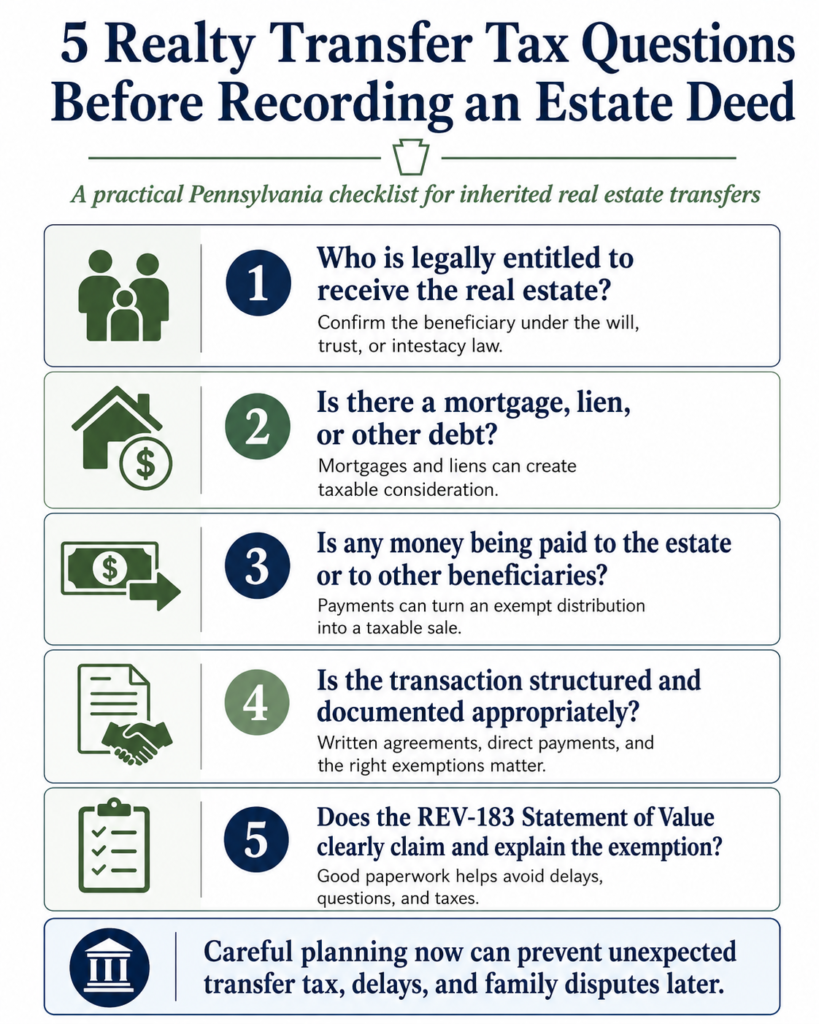
Before recording an estate deed, executors should answer the following questions:
-
- Who is legally entitled to receive the property?
-
- Is the property passing under a will, trust, or intestacy?
-
- Is there a mortgage, judgment, or lien?
-
- Is anyone paying money to the estate?
-
- Is anyone paying money directly to another beneficiary?
-
- Do family transfer exemptions potentially apply?
-
- Will the transaction involve one deed or multiple deeds?
-
- Does the REV-183 clearly explain the exemption?
-
- Is there a written beneficiary agreement?
-
- Could the executor face objections from beneficiaries?
These are not merely transfer tax questions.
They are estate administration questions that affect title, beneficiary rights, tax obligations, and executor responsibilities.
Practical Takeaways for Pennsylvania Families
Pennsylvania realty transfer tax on estate distributions can be complicated, but several practical principles apply.
First, a true estate distribution to the beneficiary entitled to receive the property may qualify for exemption.
Second, mortgages and liens can create taxable consideration.
Third, unequal distributions are not automatically taxable when beneficiaries receive their proper inheritance shares.
Fourth, beneficiary buyouts require careful planning because payments connected to inherited real estate may trigger Pennsylvania realty transfer tax.
Fifth, deeds and Statements of Value should clearly document the exemption being claimed.
The most important takeaway is simple:
Do not wait until the deed is ready for recording before evaluating Pennsylvania realty transfer tax on estate distributions.
Need Help With an Estate Deed or Inherited Home in Pennsylvania?
Ally Legal Services helps families throughout Pennsylvania with estate planning, probate, estate administration, inherited property transfers, and Pennsylvania realty transfer tax on estate distributions.
If you are serving as an executor, handling a parent’s home, or coordinating a beneficiary buyout, it is wise to review transfer tax issues before signing or recording a deed.
Our team can assist with estate planning services in Pennsylvania, inherited property transfers, and related estate matters. Families looking to create complete estate planning documents can also take proactive steps to reduce future complications involving inherited real estate.
A short review before recording an estate deed can help prevent costly transfer tax mistakes later.
This article is for general informational purposes only and is not legal advice. Realty transfer tax issues are fact-specific, and local tax rates, recording practices, and exemption requirements may vary. Consult with a qualified attorney before taking any action.