

When a parent, spouse, or loved one may need nursing home care, families often start asking urgent questions about Medicaid, the family home, bank accounts, and whether past gifts will cause problems. Pennsylvania Medicaid planning is the process of preparing for those questions before a crisis forces rushed decisions.
Medicaid can help pay for long-term care in a nursing facility when a person meets medical, financial, and residency requirements. But the rules are technical. A transfer that seems harmless, an outdated power of attorney, or a misunderstanding about the home can create delays, penalties, or avoidable family conflict.
This article explains seven common mistakes Pennsylvania families should avoid when planning for long-term care and Medicaid eligibility. It is not a substitute for legal advice, but it can help you understand when it may be time to speak with an elder law attorney.
Why Pennsylvania Medicaid Planning Matters
Long-term care planning is different from ordinary estate planning. A will controls what happens after death, but it does not help much if someone becomes ill, needs nursing home care, or cannot manage finances during life. Medicaid planning looks at practical issues such as income, assets, gifts, powers of attorney, spouse protections, and possible estate recovery during estate administration.
Pennsylvania Medicaid planning requires an assessment of eligibility for nursing home care. This is usually based on proof of medical need and financial eligibility. The rules are especially complicated for married couples because the spouse living at home may be allowed to keep certain income and resources. These protections are important, but they are not automatic in every situation.
Medicaid is also known as Medical Assistance, and the state describes it as a program that pays for health care services for eligible individuals. Families can review the state’s general information about Pennsylvania medicaid planning / Medical Assistance before beginning a long-term care planning conversation.
Good Pennsylvania Medicaid planning can help families understand their options, organize records, and avoid decisions that create preventable Medicaid problems.
Mistake One: Giving Away Assets Too Late
Many families hear that they should “give everything away” to protect assets from nursing home costs. For Pennsylvania Medicaid planning purposes, that advice can be risky.
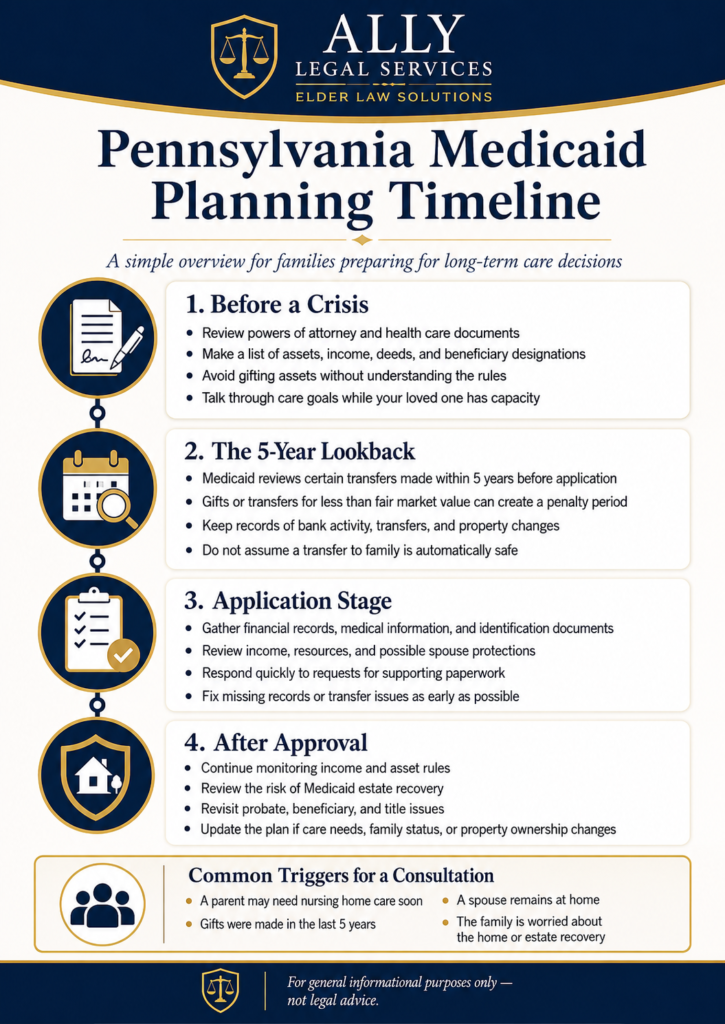
Pennsylvania Medicaid planning requires and assessment of the Medicaid transfer rules. Gifts or transfers for less than fair market value can cause a period of Medicaid ineligibility. In Pennsylvania, Medicaid caseworkers review certain transfers during a five-year lookback period. A gift that was meant to help a child, grandchild, or family member can become a problem if nursing home care is needed during that period.
This does not mean every transfer is improper. Some transfers may be allowed, and some planning strategies may be available depending on the facts. But families should not make large gifts, transfer a deed, or move money out of an older adult’s name without understanding the Medicaid consequences first.
Mistake Two: Assuming the Family Home Is Always Safe
The home is often the most emotional asset in a Medicaid planning conversation. Families may assume the home is protected because a spouse still lives there, because an adult child has been helping, or because the older adult “intends to return home.” Sometimes the home may be treated differently than other assets for eligibility purposes. But that does not mean the home is always protected from every issue.
There are at least three separate questions:
-
- Will the home count as an available resource for Medicaid eligibility?
-
- Can the home be transferred without causing a Medicaid penalty?
-
- Could the state later seek estate recovery after Medicaid benefits are paid?
Those questions have different rules. A family that focuses only on eligibility may miss later estate recovery concerns. A family that transfers a home without legal advice may create tax, Medicaid, title, or family conflict issues.
Mistake Three: Waiting Until a Nursing Home Application Is Due
Families often wait to ask for help until the nursing home is already requesting payment information. At that point, decisions may have to be made quickly. Records may be missing. Bank statements may be hard to locate. A power of attorney may not include the authority needed to complete planning steps.
Earlier Pennsylvania Medicaid planning gives families time to gather documents, review asset ownership, check beneficiary designations, understand income, and discuss care goals. Even when a crisis has already happened, legal guidance can still be valuable. But the earlier the conversation begins, the more options the family may have.
Mistake Four: Relying on an Outdated or Generic Power of Attorney
A financial power of attorney can be one of the most important documents in elder law. It allows a trusted agent to act for the principal during life. In a long-term care situation, the agent may need to access accounts, pay bills, work with benefit programs, sell or manage property, and communicate with institutions.
But not every power of attorney is equally useful. Some documents are too limited. Some do not authorize gifting or other planning steps. Some financial institutions may question older documents, even if a valid power of attorney does not automatically expire just because it is old.
Families should review powers of attorney before incapacity occurs. Once a person loses legal capacity, signing a new document may no longer be possible. The alternative may be guardianship, which is usually more expensive, stressful, and time-consuming than proper advance planning.
Mistake Five: Ignoring the Healthy Spouse’s Rights
When one spouse needs nursing home care and the other remains in the community, Medicaid rules may allow the community spouse to keep certain resources and income. These rules exist to reduce the risk that the healthy spouse will be impoverished by the other spouse’s care needs.
This is one reason married couples should be especially careful before spending down assets or accepting informal advice. The correct approach depends on the couple’s income, resources, home, debts, care needs, and timing. A plan that makes sense for a single applicant may not make sense for a married couple.
Mistake Six: Forgetting About Estate Recovery in Pennsylvania Medicaid planning
Medicaid approval is not always the end of the story. Families should also understand that Pennsylvania Medicaid Planning may involve estate recovery after a Medicaid recipient dies, especially when assets remain in the person’s probate estate. After a person who received Medicaid long-term care benefits dies, the government may seek recovery from certain assets. In Pennsylvania, estate recovery is generally connected to the person’s probate estate, meaning assets titled in the person’s name alone at death.
This issue should be reviewed as part of Pennsylvania Medicaid planning. Beneficiary designations, jointly owned property, deeds, and probate assets can all affect what happens after death. Families should not assume that avoiding probate is always simple or always appropriate. Estate recovery planning should be coordinated with tax issues, family goals, and the person’s care needs.
Mistake Seven: Treating Pennsylvania Medicaid Planning Like a Single Form
Medicaid planning is not simply filling out an application. It can involve legal documents, asset records, income calculations, medical assessments, tax questions, family communication, and deadlines. The plan may also need to change if the person’s health changes, a spouse dies, a home is sold, or a family caregiver situation changes.
A strong plan should answer practical questions:
-
- Who has legal authority to act if the older adult cannot?
-
- What assets are owned, and how are they titled?
-
- Have there been gifts or transfers within the lookback period?
-
- Is there a spouse who needs income or resource protection?
-
- What records will be needed for an application?
-
- Could estate recovery apply later?
What Families Should Do Before a Long-Term Care Crisis
Families do not need to wait until a nursing home admission to get Pennsylvania Medicaid planning organized. A practical starting point is to gather recent bank statements, retirement account information, deeds, insurance policies, income records, tax returns, powers of attorney, health care directives, and any records of gifts or transfers.
It is also wise to talk with the older adult while they still have capacity. Planning should reflect the older adult’s wishes, not just the preferences of adult children or other relatives. Elder law attorneys must be careful about who the client is, especially when family members are involved.
If family members disagree, early legal guidance may reduce conflict. It can also help prevent financial exploitation or pressure on a vulnerable older adult.
When to Contact an Elder Law Attorney
You should consider speaking with an elder law attorney if a loved one may need nursing home care, has made gifts in the last five years, owns a home, has a spouse at home, lacks updated powers of attorney, or has received a Medicaid denial or request for more information.
An attorney experienced with Pennsylvania Medicaid planning can help explain what options may be available under current law. The goal is not to hide assets or promise eligibility. The goal is to make legally informed decisions, protect the older adult’s interests, and avoid preventable mistakes.
Medicaid and Medicare are often confused, but they are not the same program. For Medicare enrollment, Medigap, Medicare Advantage, Part D prescription coverage, billing, and appeal questions, Pennsylvania families may also contact PA MEDI Medicare counseling for free, unbiased help.
Conclusion: Plan Before the Crisis
Pennsylvania Medicaid planning can be one of the most important steps a family takes when long-term care becomes a concern. The rules can affect the family home, lifetime gifts, spouse protections, powers of attorney, and estate recovery after death.
Ally Legal Services helps Pennsylvania families understand elder law options and prepare for long-term care decisions with practical, legally careful planning. If your family is worried about nursing home costs, Medicaid eligibility, or protecting a spouse at home, contact Ally Legal Services to schedule a consultation.
Disclaimer: This article is for general informational purposes only and is not legal advice. Pennsylvania Medicaid planning issues are fact-specific, and Medicaid laws, procedures, tax rules, deadlines, and eligibility requirements may vary depending on the circumstances. Consult a Pennsylvania Medicaid planning attorney before taking any action.