

Pennsylvania annual report filing is now an important yearly compliance requirement for most businesses and nonprofit entities registered to do business in Pennsylvania. The requirement began in 2025, and it applies to many domestic Pennsylvania entities and foreign entities registered in Pennsylvania.
For many small business owners, this is easy to miss. Pennsylvania previously had a decennial report system, which meant many businesses were not used to filing a routine report every year. That has changed. If a business is active with the Pennsylvania Department of State, the owner should know whether an annual report is required, when it is due, what information must be listed, and what can happen if the report is not filed.
This guide explains the basic Pennsylvania annual report filing rules in plain English. It is intended for business owners, nonprofit leaders, LLC members, corporate officers, and anyone responsible for keeping a Pennsylvania business entity in good standing.
What Is the Pennsylvania Annual Report Filing Requirement?
The Pennsylvania annual report filing is a yearly report filed with the Pennsylvania Department of State. It is not a tax return. It is not the same as a federal Beneficial Ownership Information report. It is a state business filing that keeps key public information current for an entity registered with Pennsylvania.
The Department of State’s annual report page explains that most domestic and foreign filing associations must file an annual report beginning in 2025. The report is filed through Pennsylvania’s Business Filing Services system and is strongly encouraged to be filed online.
The annual report generally confirms basic entity information, including the business name, jurisdiction of formation, registered office address, principal office address, at least one governor, principal officers if any, and the entity number issued by the Pennsylvania Department of State.
Who Must File a Pennsylvania Annual Report?
The filing requirement applies broadly. Common entities that must file include domestic and foreign:
- business corporations;
- nonprofit corporations;
- limited liability companies, including many LLCs;
- limited partnerships;
- limited liability partnerships;
- professional associations; and
- business trusts.
Some filing types are not required to make annual reports. The Department of State lists examples such as fictitious names, general partnerships that are not limited liability partnerships, name reservations, certain authorities, trademarks, and similar filings.
The safest starting point is to search the business through the Department of State’s business search and confirm whether the entity is active. If the entity is active or some variation of active, annual report compliance should be treated as a live issue.
Pennsylvania Annual Report Filing Deadlines
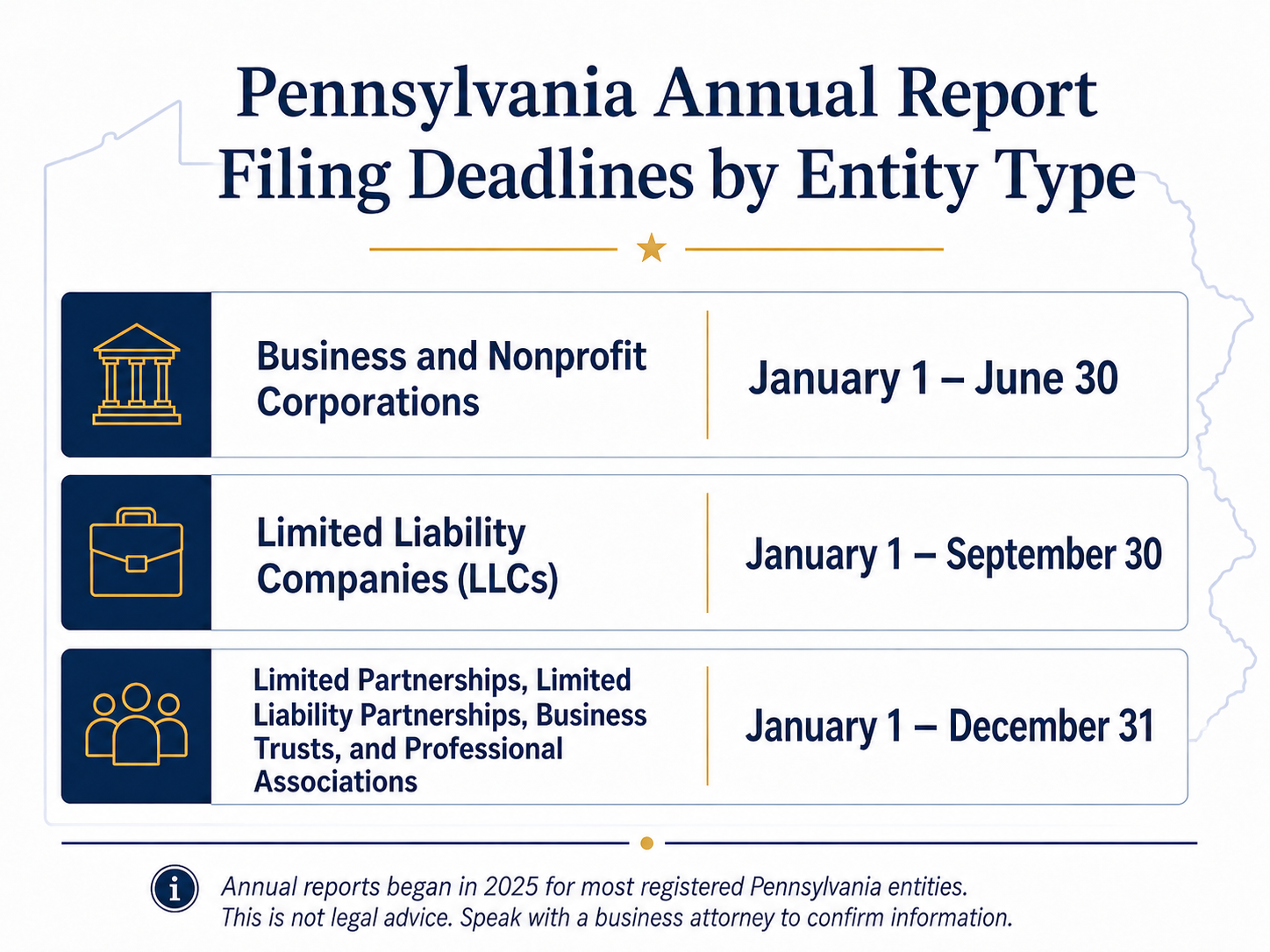
The deadline depends on the type of entity. This is where owners should be careful, because not every business has the same filing window.
| Entity Type | Annual Filing Window |
|---|---|
| Business and nonprofit corporations, domestic and foreign | January 1 through June 30 |
| Limited liability companies, domestic and foreign | January 1 through September 30 |
| Limited partnerships, limited liability partnerships, business trusts, professional associations, domestic and foreign | January 1 through December 31 |
A business formed or registered in Pennsylvania does not need to file the report in the same calendar year it is first formed or registered. The first report is due the year after formation or initial foreign registration.
Do not rely only on receiving a notice. The Department of State may send postcard or email notices, but failure to receive a notice does not remove the filing obligation.
How Much Does the Pennsylvania Annual Report Cost?
The annual report fee is modest, but the compliance consequences can be significant. The filing fee is generally:
- $7 for business corporations, LLCs, LPs, and LLPs; and
- $0 for nonprofit corporations and certain LPs or LLCs with a not-for-profit purpose.
Because online annual reports are automatically processed, the Department of State states that there are no expedited service options for annual reports. Online filing is usually the fastest route.
How to File the Annual Report Online
The Department of State directs filers to use Business Filing Services at file.dos.pa.gov. The official process generally works like this:
- Create or log into a Business Filing Services account.
- Search for the company under the Business Search section.
- Select the business or association from the search results.
- Click the annual report filing option. The Department states that no PIN access is required to file an annual report.
- Review and update the entity information that appears in the form.
- Confirm registered office information, principal office information, governor information, and principal officers if applicable.
- Electronically sign the report and submit it online.
- Pay the filing fee if a fee applies.
- Download the filed report and acknowledgement once processed.
The Department of State has published a detailed annual report filing help guide with screenshots. Business owners can also review the Department’s main Pennsylvania annual reports page and its one-page annual report infographic.
What Information Should Be Checked Before Filing?
A rushed annual report can create avoidable problems. Before filing, confirm the following information is current:
- the exact business name;
- the Pennsylvania Department of State entity number;
- the jurisdiction where the entity was formed;
- the registered office address or commercial registered office provider;
- the principal office address;
- the name of at least one governor, such as a director, manager, member, partner, or similar person depending on entity type; and
- principal officer names and titles, if the entity has them.
No financial information is required on the annual report. The report is about entity identity, address, governance, and compliance information, not revenue, profit, bank balances, or tax details.
Annual report information is public. That means owners should think carefully about the addresses and people listed on the filing. The information should be accurate, but owners should understand that the report becomes part of the public-facing Department of State record.
What Happens If a Business Misses the Annual Report?
Missing a Pennsylvania annual report filing can eventually create serious consequences. Under the transition rules described by the Department of State, enforcement consequences begin with annual reports due in 2027. A failure to file can lead to administrative dissolution, termination, or cancellation, depending on the type of entity.
That should not be treated as a harmless technicality. If an entity is administratively dissolved, cancelled, or terminated, it can lose the protection of its name. A domestic entity may have a reinstatement path, but reinstatement may involve fees and may not fully solve every problem if another entity has taken the name. A foreign entity may need to re-register rather than reinstate retroactively.
For an active business, missed filings can also create practical headaches. Lenders, buyers, landlords, vendors, licensing agencies, and opposing parties in a dispute may care whether the entity is in good standing. Compliance problems tend to show up at the worst time: during a loan, sale, contract negotiation, ownership dispute, or litigation.
Common Annual Report Mistakes to Avoid
Several mistakes are predictable.
-
Assuming the Report Does Not Apply to LLCs
LLCs are included. Domestic and foreign LLCs have an annual filing window of January 1 through September 30.
-
Confusing the Annual Report With BOI Reporting
The Pennsylvania annual report filing is separate from federal Beneficial Ownership Information reporting. The Department of State specifically distinguishes the Pennsylvania annual report from BOI reporting through FinCEN.
-
Ignoring Address Updates
The Department of State sends notices based on information on file. If the registered office or notification email is outdated, the business may miss reminders but still remain responsible for filing.
-
Assuming a Closed Business Is Automatically Inactive
Stopping operations or completing a Pennsylvania Department of Revenue out-of-existence affidavit does not necessarily make the entity inactive with the Department of State. If the Department of State still lists the association as active, annual report obligations may remain.
-
Confusing Annual Reports With Certificates of Annual Registration
Some professional or partnership entities may have separate Certificate of Annual Registration obligations. For example, LLPs, LLLPs, and restricted professional companies may still have CAR requirements. The annual report does not automatically replace every other entity filing.
When Should a Business Owner Get Legal Help?
Many simple annual reports can be filed directly by the business owner. Legal help becomes more valuable when the filing raises a larger issue, such as:
- unclear ownership or management authority;
- outdated governing documents;
- uncertainty about who should be listed as a governor or officer;
- a business that has stopped operating but was never dissolved or terminated;
- a foreign entity registered in Pennsylvania;
- a professional entity with separate compliance obligations; or
- a business preparing for sale, financing, succession planning, or an ownership dispute.
Annual reporting is not just paperwork when the underlying business records are wrong. If the ownership records, operating agreement, corporate minutes, officer structure, or registered address are outdated, the annual report may expose a problem that should be cleaned up rather than copied forward.
Ally Legal Services helps Pennsylvania business owners with business formation, entity cleanup, governance questions, contracts, and ongoing advisory support. For owners thinking beyond yearly compliance, ongoing business legal guidance can help keep filings, contracts, and company records aligned before problems develop.
Bottom Line on Pennsylvania Annual Report Filing
Pennsylvania annual report filing is now part of the yearly maintenance routine for most Pennsylvania business entities and foreign entities registered in the Commonwealth. The filing is usually simple, inexpensive, and fastest online, but ignoring it can create real legal and practical risk over time.
Business owners should calendar the correct deadline, confirm the entity’s Department of State information, file online when possible, and keep proof of the filed report. If the annual report reveals outdated ownership, management, address, or entity records, the better move is to fix the underlying issue rather than treat the report as a formality.
For help reviewing entity records, cleaning up business filings, or planning ongoing legal compliance, contact Ally Legal Services to discuss practical next steps for your Pennsylvania business.
Disclaimer: This article is for general informational purposes only and is not legal advice. Pennsylvania annual report filing issues are fact-specific, and business filing requirements, entity status, deadlines, and related compliance obligations may vary depending on the circumstances. Consult an attorney before taking any action.